INDUSTRY TRENDS

Açaí Powder Sourcing Playbook (2026): Use Input-Price Lags to Protect Cost and Continuity

Author
Team Tridge
DATE
April 27, 2026
8 min read
acai-powder Cover

This guide is for procurement leaders who buy açaí powder but don’t live in the Amazon supply chain every day. The core message is simple: açaí powder pricing often adjusts after upstream pulp tightens, and that lag creates a short negotiation window—if you benchmark like-for-like grades and keep a qualified backup path warm.
Executive Summary

  • Açaí is highly seasonal and origin-concentrated (Brazil—especially Pará—dominates), so harvest timing and river/logistics friction can tighten pulp quickly. [1]
  • Powder quotes can “lag” pulp moves because suppliers sell through inventory and manage drying capacity; use that lag as a contracting window rather than waiting for the catch-up step.
  • Benchmark like-for-like (drying method, carrier %, claim set, pack format, service level) because “açaí powder” is not a single comparable grade. [2]
  • Pre-qualify backups before disruption; switching is rarely instant due to documentation, samples, and QA validation.
  • (Analyzed at: Apr, 2026) Ocean container rates are broadly stable/softer versus prior spike periods, so “freight” is less credible as a blanket excuse unless your lane/booking reality differs. [3]

1) The Market Signal You’re Missing: Why Açaí Powder Prices “Lag” When Pulp Moves

  • Insight: In açaí powder, the cleanest negotiation windows appear when upstream inputs (berries/pulp + energy + freight) move quickly, but finished powder quotes move slowly—because many suppliers are selling through inventory, protecting drying capacity margins, or leaning on “quality narratives” to hold price.
  • Data (directionally realistic pattern): Procurement teams often observe a timing gap, but the exact percentages vary by grade (spray-dried vs. freeze-dried), carrier level, and whether the supplier is vertically integrated.
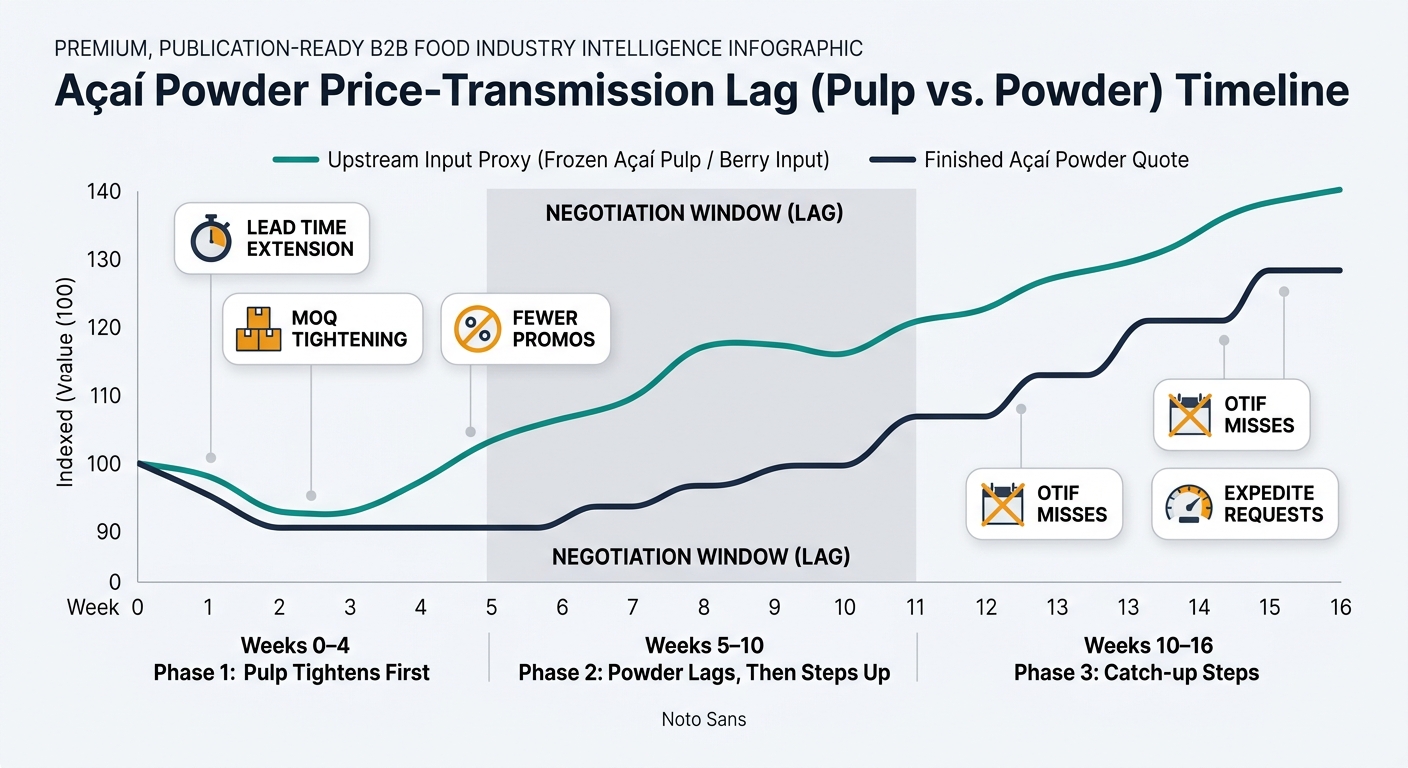
  • Week 0–4: Frozen pulp tightens and rises (often first visible as longer lead times, tighter MOQ discipline, or fewer “promo” offers) on weather/logistics friction; suppliers with committed pulp inventory keep powder offers flat.
  • Week 5–10: Powder quotes step up with a delay (lag), because powder in-market reflects pulp bought weeks earlier and because some suppliers standardize output (commonly via spray drying with carriers) to protect throughput and consistency. [2]
  • Week 10–16: If pulp remains tight, powder catches up in steps as inventory clears and drying schedules reset; “expedite” airfreight and short-shipments often show up first as service failures (OTIF), not immediately as price.
Dual-line indexed timeline over 16 weeks showing upstream frozen açaí pulp/berry input moving first and finished açaí powder quotes stepping up later, with a shaded negotiation window (lag) and callouts for early signals (lead time extension, MOQ tightening, fewer promos) and later signals (OTIF misses, expedite requests), divided into Week 0–4, Week 5–10, and Week 10–16 phases.

Procurement Impact: If you only track finished powder quotes, you often buy at the moment suppliers regain pricing power (after the lag closes). The alpha move is to negotiate during the lag—when your supplier is still quoting off older inventory but already feeling replacement-cost pressure.

The two disconnects that create exploitable buying windows

  • Insight: Most açaí powder “price surprises” are not random—they’re driven by (1) inventory timing and (2) spec-managed substitution inside the powder itself.
  • Data: Two recurring anomalies:
  • Inventory timing disconnect: A supplier with ~8–12 weeks of pulp/WIP/finished-goods coverage can resist immediate price decreases when pulp falls—and delay price increases when pulp rises. That delay is your window.
  • Spec-managed substitution disconnect: When pulp cost spikes, some suppliers protect margin by shifting the product mix toward spray-dried + carrier-standardized output, while holding “premium” (lower-carrier or freeze-dried) grades at a higher floor. (Carrier use is common in spray-dried açaí powder specifications.) [2]

Procurement Impact: You should benchmark like-for-like (drying method, carrier %, claim set, pack format, and service level). Otherwise, you negotiate against a market reference that is quietly drifting away from your spec.
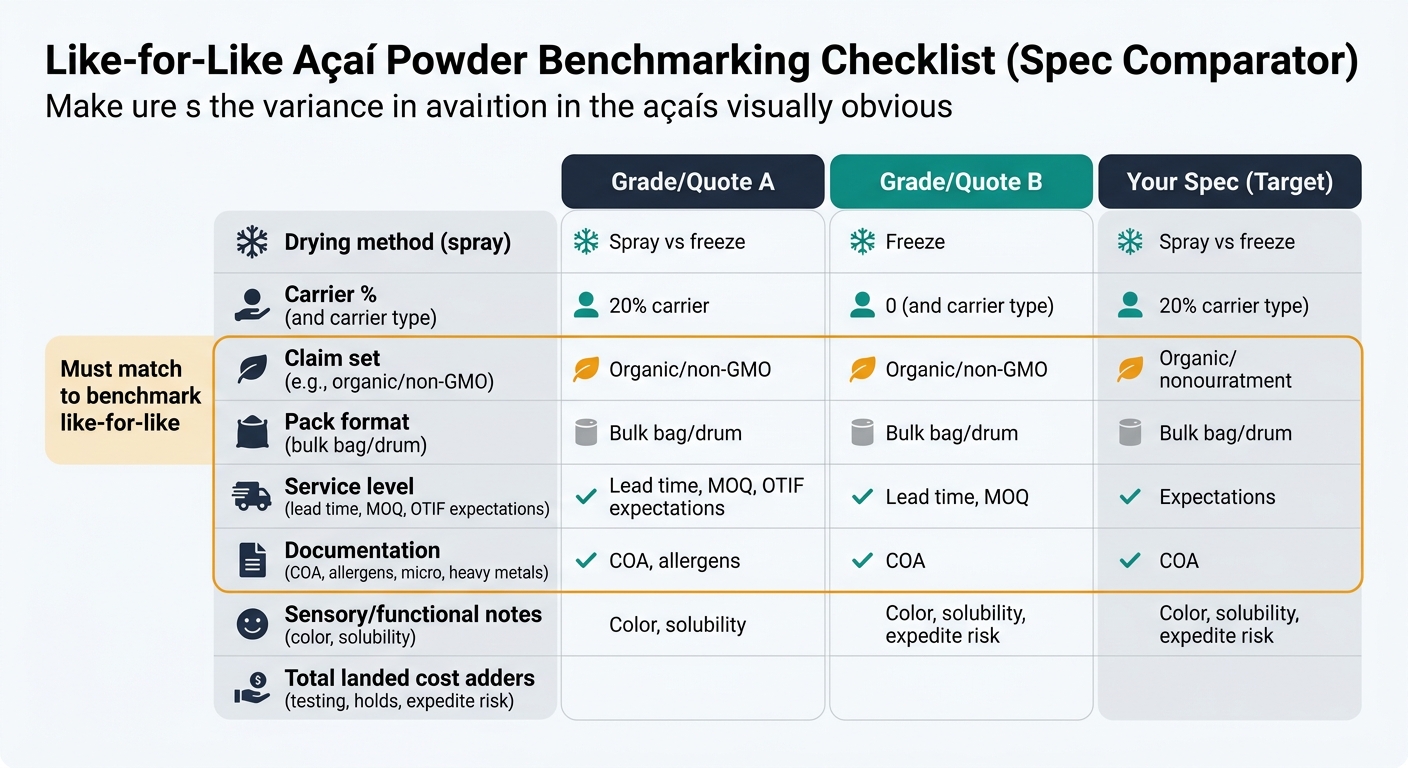
Matrix-style procurement worksheet comparing Grade/Quote A, Grade/Quote B, and Your Spec across rows including drying method (spray vs freeze), carrier percent and type, claim set (e.g., organic/non-GMO), pack format, service level (lead time, MOQ, OTIF), documentation (COA, allergens, micro, heavy metals), sensory/functional notes (color, solubility), and total landed cost adders (testing, holds, expedite risk), with a highlighted group labeled must match to benchmark like-for-like.

A concrete negotiation example (numbers you can use)

  • Insight: The best leverage often comes from decomposing a supplier’s quote into what changed vs. what didn’t—then trading term length and volume shape for a smaller immediate increase.
  • Data (use as a template, not a “market fact”): Example: your incumbent raises a quote from $12.00/kg → $13.20/kg (+10%) citing “origin tightness.” Your intelligence shows:
  • Pulp replacement cost is up materially, but your supplier likely has 6–10 weeks of lower-cost inventory.
  • Ocean freight is flat to softer in early April 2026 at a global index level, so freight should be validated lane-by-lane (and evidenced with bookings/invoices) rather than accepted as a general surcharge. [3]
  • Energy cost pressure (drying) is real, but it impacts suppliers unevenly depending on where drying occurs, utilization, and whether they run spray vs. freeze drying.

A practical counter-structure:

  • Hold near-term price to $12.60–$12.90/kg for 60–90 days (partial pass-through),
  • Add a conditional step-up if a defined input proxy remains elevated for 6+ weeks,
  • Trade for forecast visibility and volume smoothing (less peak-week demand).

Procurement Impact: This structure converts a supplier’s “replacement-cost story” into a time-bound, auditable mechanism—and it reduces the chance you lock a peak price right as the lag closes.

Key Takeaways

  • Lag is your leverage: Negotiate when upstream costs have moved but downstream quotes haven’t fully adjusted.
  • Benchmark the exact grade: Market “açaí powder” averages can hide mix shifts between premium and standardized grades.
  • Convert narratives into mechanisms: Use conditional step-ups/step-downs tied to observable proxies, not open-ended increases.

2) Where Procurement Teams Usually Lose Money (and Don’t Notice)

Mistake #1: Treating all “açaí powder” quotes as comparable

  • What happens: Teams run an RFQ and line up quotes that look similar on paper, then award to the lowest.
  • Why it fails: Suppliers can meet the headline description while varying the commercial reality—service levels, lot consistency, carrier standardization practices, and how aggressively they manage moisture/humidity exposure in storage and transit.
  • The hidden cost: A $0.60/kg “saving” disappears when you add (a) extra inbound testing, (b) higher reject/hold rates, and (c) expediting to cover late OTIF. In practice, effective landed cost can swing +3–8% even when unit price is lower.

Mistake #2: Waiting for a disruption to qualify backups

  • What happens: The business stays single-sourced until a late shipment, failed COA trend, or sudden allocation event forces a scramble.
  • Why it fails: Açaí powder switching is rarely instant—samples, spec alignment, documentation, and trial runs create a weeks-to-months timeline. In a tight market, new suppliers prioritize existing customers.
  • The hidden cost: You end up paying “panic premiums” (often +8–15% vs. normal) or accepting spec compromises that create downstream brand/quality risk. The opportunity cost is the negotiating leverage you lost by not having a credible second source.

Mistake #3: Signing annual fixed-price deals without a volatility escape hatch

  • What happens: Teams lock a 12-month price to protect budgets, then get hit with service failures or mid-year renegotiations.
  • Why it fails: Fixed-price without clear allocation rules, lead-time commitments, and input-driven adjustment logic incentivizes suppliers to protect themselves operationally (ship later, allocate, or push substitutions) when costs spike.
  • The hidden cost: You “win” the price but lose continuity—production planners carry more safety stock, QA handles more deviations, and procurement spends time on firefighting. The cost shows up as working capital + downtime risk, not as a line-item price increase.

3) What Changes When You Run Açaí Like an Intelligence-Led Category

  • Insight: The measurable gains come less from squeezing unit price and more from reducing avoidable volatility—price spikes, expedite freight, and quality-related disruption.
  • Data (directional before/after for a mid-sized buyer):
Dimension Before (quote-driven) After (intelligence-led)
Supplier universe 2–3 known vendors 8–15 mapped suppliers (incl. credible backups)
Benchmarking cadence Quarterly, anecdotal Monthly, lag-aware (inputs + finished quotes)
Contract posture Fixed annual or spot Hybrid: 60–90 day holds + conditional adjustments
Disruption exposure 2–3 “surprises”/year 0–1 major surprise/year (mitigated earlier)
Cost of poor quality (COPQ) Frequent holds/retests Fewer deviations via tighter governance

Procurement Impact: Typical outcomes procurement can defend internally (when volatility is present):

  • 6–12% improvement vs. “buy-at-peak” spot behavior in volatile periods (not every quarter—specifically when lags widen).
  • Fewer expedite shipments and fewer production schedule changes because second sources are pre-qualified.
  • Better auditability: supplier selection and price moves tied to documented signals (not gut feel).

4) Three Situations Where This Playbook Pays Off Fast

Use case #1: Your renewal is in 60 days and pulp is moving, but powder quotes aren’t

  • Insight: The lag window is open; your supplier’s replacement costs are rising, but their current inventory still anchors quotes.
  • Data: If upstream moves +10–18% and powder has only moved +0–5%, you’re in the negotiation gap.
  • Procurement Impact: Push for a shorter initial price hold (60–90 days) with a clearly defined adjustment trigger, rather than accepting an immediate full pass-through.

Use case #2: QA flags a drift in lot-to-lot performance and the supplier says “seasonality”

  • Insight: “Seasonality” can be real, but it’s also a convenient umbrella for supplier-specific process drift.
  • Data: Compare your incoming-lot outcomes across suppliers (holds, retests, sensory complaints, solubility issues) against shipment timing and lane conditions; if only one supplier is deteriorating, it’s not origin-wide.
  • Procurement Impact: Use the evidence to negotiate corrective actions + service credits or to accelerate onboarding of a backup supplier without waiting for a full failure.

Use case #3: A competitor locks forward volume and your incumbent hints at allocation

  • Insight: Allocation risk often shows up first as longer lead times and “order smoothing” requests, not as formal notices.
  • Data: Early warning signals include repeated partial shipments, longer confirmations, or MOQ changes.
  • Procurement Impact: Shift part of the next quarter’s volume to a pre-qualified secondary supplier and renegotiate allocation rules (who gets cut first, by how much, and with what notice).

5) Why This Same Approach Works in Your Other Ingredient Categories

  • Insight: Açaí is a clean example of a broader procurement truth: finished-goods prices don’t move in lockstep with upstream inputs when processing capacity, inventory cycles, and spec-managed substitutions exist.
  • Data: Similar patterns show up in categories you likely buy:
  • Cocoa powder: bean moves vs. powder moves can lag due to grind capacity and inventory.
  • Vanilla extracts/flavors: cured bean scarcity transmits unevenly depending on inventory positions and formulation adjustments.
  • Freeze-dried fruit powders (berry set): energy/capacity constraints create price floors even when raw fruit softens.

Procurement Impact: Build one repeatable operating model: track upstream proxies, map conversion bottlenecks, and negotiate contracts that reflect lag + substitution realities rather than “annual fixed by default.”

6) Why This Açaí Example Is the Proof (Not the Pitch)

  • Insight: The advantage isn’t “more data.” It’s having the right signals organized around the decisions you actually make: when to lock, when to float, when to dual-source, and when to escalate.
  • Data: In açaí powder, small timing errors (buying after the lag closes) and small governance gaps (no backup qualified) compound into outsized business impact—premium freight, stockout risk, and quality incidents that consume cross-functional time.
  • Procurement Impact: If your team can consistently (1) detect lag windows, (2) benchmark like-for-like grades, and (3) maintain a living backup pipeline, you stop paying for surprises—and you can defend your strategy to finance, QA, and leadership with evidence.

7) The Bottom Line for Your Next Move

If upstream signals are already moving but your current açaí powder quotes haven’t fully adjusted, treat the next 60–90 days as a negotiation window, not a buying deadline. Use that lag to secure a short-term price hold with a conditional adjustment mechanism—so you avoid locking a peak price right as the market catches up. Teams that consistently act during these lag windows tend to outperform reactive spot buying in volatile periods, not because they “predict” the market, but because they stop paying the full volatility tax after it’s already priced in.

The Bottom Line for Your Next Contract

(Analyzed at: Apr, 2026)
Açaí supply remains structurally seasonal—most harvest volume is concentrated in a short main season—so the smartest contract you can sign now is one that assumes timing shocks will happen and prices won’t transmit cleanly. [1]

Build a 60–90 day hold with a transparent step mechanism and, critically, pre-award 20–30% of volume to a qualified secondary that matches your exact grade (drying method and carrier %) so you can actually move volume when OTIF or quality drifts. [2]

In 2026’s steadier ocean-rate environment, the avoidable cost is less “freight inflation” and more the 8–15% panic premium you pay when you have no credible alternative and the lag closes on you. [3]
References

  1. apps.fas.usda.gov
  2. abrazil.com
  3. drewry.co.uk
Subscribe
By subscribing you agree to with our Privacy Policy and provide consent to receive updates from our company.
Thank you! Your submission has been received!
Oops! Something went wrong while submitting the form.
Subscribe to receive the latest blog posts, updates, promotions, and announcements from Tridge.