INDUSTRY TRENDS

A Practical Decision Tree for Buying Clarified Mango Juice Concentrate (Quality/Safety/Compliance-First)

Author
Team Tridge
DATE
July 31, 2026
10 min read
clarified-mango-juice-concentrate Cover
Unlock Full Data
Clarified Mango Juice Concentrate Market Intelligence
Prices · Trends · Origins · Forecasts

This decision tree is built for the real buyer moment: you’re not just “picking a supplier,” you’re choosing a sourcing strategy that will survive spec interpretation, COA comparability, aseptic/logistics constraints, and U.S. importer verification expectations. It’s written for procurement + QA/compliance teams who know sourcing—but don’t want to learn mango concentrate the hard way.
Executive Summary

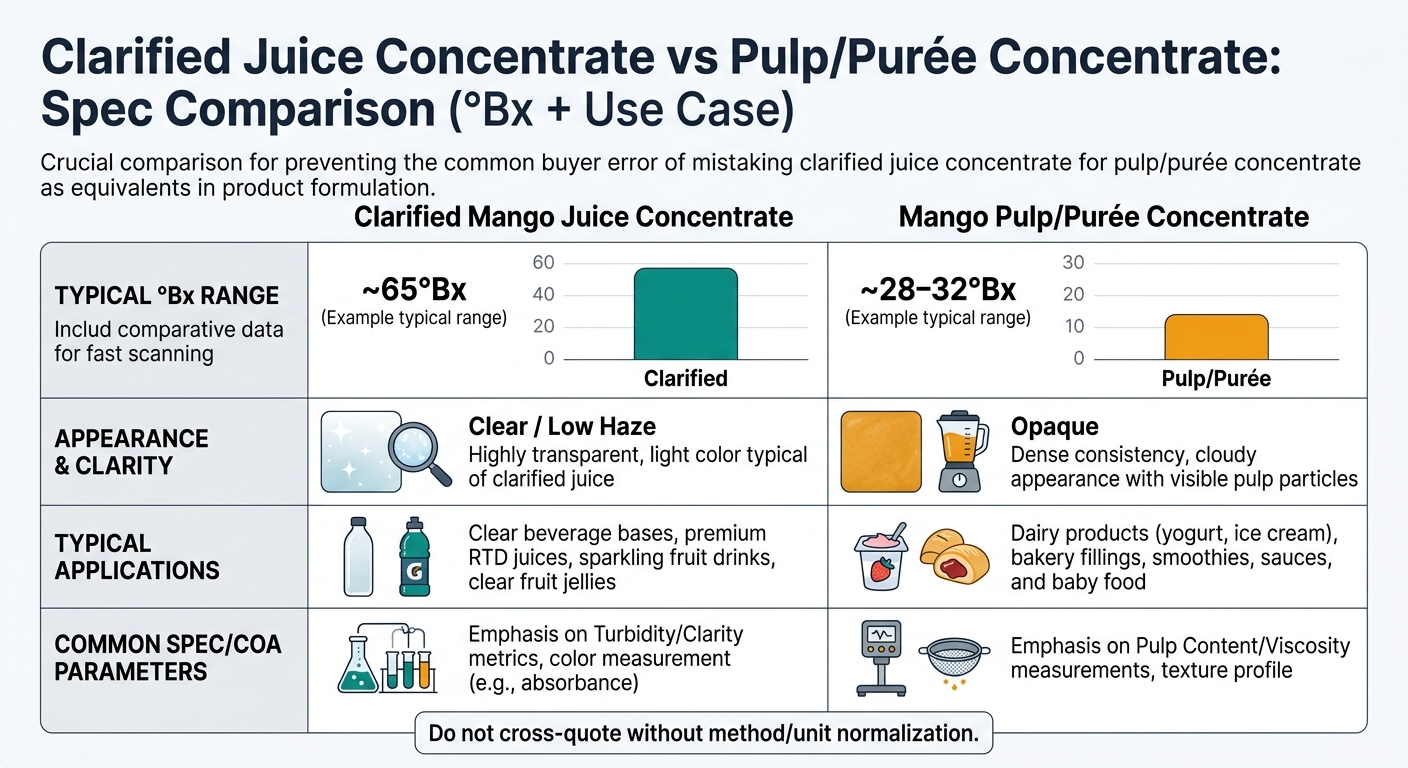
  • Two product families get confused: clarified mango juice concentrate often trades around ~65°Bx for clear beverage applications, while mango pulp/purée concentrates are commonly ~28–32°Bx—don’t compare them as equivalents. [1]
  • Side-by-side comparison table with a mini bar chart showing clarified mango juice concentrate (~65°Bx) versus mango pulp/purée concentrate (~28–32°Bx), including appearance, typical applications, and common spec/COA parameters, plus a footnote warning not to cross-quote without method/unit normalization.
  • Most failures happen at “interfaces”: spec ↔ COA ↔ test method ↔ process controls ↔ lane/packaging.
  • U.S. import reality: under FSVP, documentation quality and verification planning are operational gating items, not paperwork. [2]
  • 2026 market lens: weather-driven tightness (notably Peru) has been linked to firmer mango pricing dynamics—resilience planning matters more when origin economics tighten. [3]

1) What this framework helps you decide (and why mango concentrate punishes improvisation)

Insight: Clarified mango juice concentrate sourcing decisions fail most often at the “interfaces” (spec ↔ COA ↔ process controls ↔ logistics), so a decision tree beats ad‑hoc supplier shopping.

Data: Clarified mango juice concentrate typically moves through a short, high-throughput seasonal campaign at origin (fruit → pulping → enzymatic treatment/filtration/clarification → evaporation → aseptic filling), then ships globally as bulk concentrate in drums/IBCs; supplier specs and COA parameter sets vary widely, even when the product name is the same. [4]

Procurement Impact: A structured approach reduces late-stage rejections (spec mismatch), avoids “cheap-but-costly” awards (verification burden), and prevents continuity surprises (seasonality + packaging + freight constraints).

  • Quick Win: Before you compare quotes, lock three things:
  • your application-critical quality limits (clarity/turbidity + color + flavor),
  • your compliance must-haves (FSVP/traceability documentation), and
  • your logistics reality (ambient aseptic vs frozen lane).

2) Executive summary you can use in a kickoff meeting

Insight: This framework is designed for the exact moment procurement needs to choose a sourcing strategy—not just pick a supplier.

Data: The most common triggers are (a) new product launch needing clarified appearance stability, (b) repeated incoming QC disputes due to non-comparable COAs, (c) origin disruption risk during harvest windows, or (d) a cost-down initiative that can’t increase food safety/fraud exposure.

Procurement Impact: You get to one of five outcomes: (1) single-source with enhanced assurance, (2) dual-source by origin, (3) dual-source within origin (capacity hedge), (4) distributor/blender model for spec standardization, or (5) temporary spot coverage with tight receiving controls.

When to use this framework (trigger conditions)

  • New supplier onboarding: You need approval in ≤ 8–12 weeks and can’t afford audit rework.
  • Spec disputes: ≥ 2 lots/quarter on hold due to COA method/parameter mismatch.
  • Continuity concern: You rely on one origin or one aseptic line.
  • Cost-down pressure: You’re asked to switch origin/supplier without expanding QA headcount.

Inputs you’ll need (minimum dataset)

  • Demand: Annual volume (MT), monthly cadence, and minimum safety stock weeks.
  • Quality: Target °Brix, acidity/pH window, clarity/turbidity requirement, sensory guardrails.
  • Compliance: Required certificates (GFSI-recognized scheme if applicable), allergen statement, traceability depth, change control.
  • Verification: Your standard incoming tests + any authenticity testing.
  • Logistics: Pack format (aseptic bag-in-drum/IBC vs frozen), Incoterms, lane/lead time tolerance.

Decision paths (high level)

  • Path 1: High volume + high service level → build dual-source + pre-qualification bench.
  • Path 2: Tight clarified spec → narrow supplier pool; pay premium or increase verification.
  • Path 3: Urgent coverage → controlled spot buy with elevated receiving + rapid doc gating.

3) The decision tree (use this as your internal sourcing playbook)

Printable procurement decision tree flowchart for clarified mango juice concentrate sourcing: Decision Point 1 splits into Path A (Resilience-first) and Path B (Cost/Control-first), with subsequent decision points leading to recommendations A1–A4 and B1–B4 using diamonds for decisions and rectangles for recommendations.

Insight: Your best strategy depends less on “country X vs country Y” and more on the intersection of volume, clarified-spec tightness, and assurance capacity.

Data: Mango concentrate is frequently sold in two easily-confused families: clarified mango juice concentrate commonly referenced around ~65°Bx for clear beverage applications, while mango pulp/purée concentrates are often around ~28–32°Bx (different use cases, different comparability). COA methods also differ (some suppliers reference IFU methods). [1]

Procurement Impact: The tree below forces early choices that prevent the two classic failures: (1) approving a supplier that can’t consistently hit clarified performance, or (2) awarding a low price that requires expensive assurance to be safe.

Decision Point 1: How exposed are you to a supply interruption? (Volume + service level)

  • If annual volume ≥ 100 MT OR stockout cost is “high” (line stoppage/customer penalty): → follow Path A (Resilience-first)
  • If annual volume < 100 MT AND you can buffer ≥ 10–12 weeks inventory: → follow Path B (Cost/control-first)

Decision Point 2 (Path A): Can you tolerate any spec drift in clarity/appearance?

  • If clarified appearance is consumer-visible (clear beverage bases, low haze tolerance) OR you’ve had turbidity-related claims: → go to Decision Point 3A
  • If minor haze/color drift is acceptable (blends, dairy, bakery fillings): → go to Decision Point 4A

Decision Point 3A (Resilience + tight clarified spec): Do you have QA capacity to run enhanced verification?

  • If you can add verification (e.g., tighter receiving + periodic authenticity screens + faster CAPA cycles): → Recommendation A1: Dual-source by origin + risk-tiered verification
  • What it looks like: Two approved suppliers in two origins; one “primary” and one “ready backup.”
  • If QA bandwidth is constrained (can’t add tests/audits): → Recommendation A2: Pay for process maturity (top-tier aseptic/QA) + keep a warm bench
  • What it looks like: One primary, but pre-reviewed alternates with ready-to-activate documentation.

Decision Point 4A (Resilience + moderate spec flexibility): Is your biggest risk price spikes or physical availability?

  • If physical availability is the risk (harvest concentration, capacity constraints): → Recommendation A3: Dual-source within origin + capacity hedge
  • If price volatility is the risk: → Recommendation A4: Split volumes across contract windows (staggered commitments)

Decision Point 2 (Path B): Are you trying to qualify a new supplier fast (≤ 6 weeks)?

  • If yes: → go to Decision Point 3B
  • If no (≥ 8–12 weeks): → go to Decision Point 4B

Decision Point 3B (Cost/control + urgent): What is your tolerance for receiving holds?

  • If you can tolerate holds (you have buffer stock): → Recommendation B1: Controlled spot buy + elevated receiving controls
  • If you cannot tolerate holds: → Recommendation B2: Buy through a standardizing intermediary (distributor/blender) + lock COA template

Decision Point 4B (Cost/control + normal timeline): How strict are your compliance/documentation requirements under U.S. import controls?

  • If you require strong importer verification alignment (FSVP readiness, traceability depth, documented hazard controls): → Recommendation B3: Supplier tiering + audit prioritization + standardized COA
  • Why: U.S. importers have defined responsibilities under FSVP; documentation quality becomes a gating factor, not a “nice to have.” [2]
  • If requirements are lighter (non-U.S. destination or low-risk channel) but brand risk is still high: → Recommendation B4: Cost-first award with authenticity guardrails

4) Scenario walkthroughs (three common buyer realities)

Insight: The same ingredient can justify opposite sourcing strategies depending on how you use it and how fragile your continuity is.

Data: Supplier specs and COA parameter sets vary (e.g., high-Brix clarified specs vs ~28–32 °Brix pulp/purée concentrates), and juice categories are known targets for economic fraud, which shifts the “minimum viable verification plan.” [4]

Procurement Impact: These walkthroughs show how to defend your strategy internally (QA, Ops, Finance) without relying on vague “supplier reputation” arguments.

Scenario A — High-volume beverage base, clarified appearance is non-negotiable

  • Buyer profile: 250 MT/year; clear beverage base; stockout stops filling line.
  • Path: Decision Point 1 → Path A → Decision Point 2 (tight clarity) → Decision Point 3A.
  • Choice: QA can add verification → Recommendation A1 (Dual-source by origin + risk-tiered verification)
  • Why each step leads there:
  • Volume/service level: Forces resilience.
  • Clarified appearance: Tightens eligible suppliers; you can’t rely on “close enough” turbidity.
  • QA capacity exists: Better to spend on planned verification than emergency firefighting.

Scenario B — Medium volume dairy inclusion, moderate spec flexibility, cost-down mandate

  • Buyer profile: 60 MT/year; mango goes into yogurt prep; slight haze acceptable; finance wants cost-down.
  • Path: Decision Point 1 → Path B → Decision Point 2 (not urgent) → Decision Point 4B.
  • Choice: Strong documentation needed for U.S. import → Recommendation B3 (Supplier tiering + audit prioritization + standardized COA)
  • Why: You can pursue cost-down, but only if the documentation and hazard-control story is clean enough to support importer verification obligations. [2]

Scenario C — Emergency replacement after a supplier deviation (edge case)

  • Buyer profile: 30 MT/year; current supplier has repeated COA disputes; you need coverage in 4–5 weeks.
  • Path: Decision Point 1 → Path B → Decision Point 2 (urgent) → Decision Point 3B.
  • Choice: You can tolerate receiving holds → Recommendation B1 (Controlled spot buy + elevated receiving controls)
  • Why: Speed forces compromises; the only safe lever is tightening inbound gating (COA comparability + targeted tests) until you complete full qualification.

5) Action matrix (match your situation to a defensible strategy)

Insight: The “right” strategy is the one that minimizes total landed cost plus cost-to-assure quality, given your service level.

Data: Verification intensity rises when specs are tight, when trading routes are complex, or when fraud vulnerability is higher; juice categories have documented exposure to economic fraud, pushing buyers toward authenticity guardrails in higher-risk situations.

Procurement Impact: Use this table to align Procurement + QA + Finance on why a lower unit price may not be the lowest total cost.

Buyer Profile Key Factors Recommended Strategy Expected Outcome
High-volume, high service level ≥100 MT/year; stockout intolerable Dual-source by origin + risk-tiered verification (A1) Fewer disruptions; fewer emergency deviations
Tight clarified spec (appearance-critical) Low turbidity tolerance; consumer-visible Pay for process maturity + keep warm bench (A2) Lower assurance burden; faster continuity response
Moderate spec, availability risk Harvest/capacity pinch points Dual-source within origin + capacity hedge (A3) Reduced allocation risk during peak season
Cost-down with compliance gating U.S. import; strong doc expectations Supplier tiering + standardized COA + audit prioritization (B3) Fewer border/receiving surprises; defensible awards
Urgent replacement ≤6 weeks; limited time for audits Controlled spot buy + elevated receiving controls (B1) Short-term continuity with managed risk

6) Risk mitigation by decision path (what to watch, what to do next)

Insight: Every sourcing strategy has a predictable failure mode; you can pre-define triggers so you don’t debate risk only after a deviation.

Data: FDA materials emphasize importer responsibilities under FSVP—making documentation quality and verification planning operational necessities, not paperwork. [2]

Procurement Impact: You reduce surprises by turning “risk” into measurable triggers (COA drift, CAPA cycle time, lane delays, spec variance) with pre-approved contingencies.

For Recommendation A1 (Dual-source by origin + risk-tiered verification)

  • What to watch for:
  • COA drift: Brix/pH/acidity trending toward limits across consecutive lots.
  • Process control signals: Aseptic fill deviations, repeated micro re-tests.
  • Contingencies:
  • Volume reallocation rule: Shift 20–40% volume to backup upon 2 consecutive major deviations.
  • Inventory buffer: Increase safety stock by 2–4 weeks during origin transition windows.
  • Monitoring metrics & triggers:
  • OTIF by lane: <95% for 2 months triggers lane review.
  • Nonconformance rate: >2% lots on hold triggers enhanced receiving.
  • Common mistakes:
  • Mistake: “Dual-source” on paper but no pre-aligned COA template → disputes persist.

For Recommendation A2 (Pay for process maturity + keep warm bench)

  • What to watch for:
  • Single-point-of-failure: One aseptic line / one site.
  • Contingencies:
  • Warm bench readiness: Pre-approve alternates’ document packs and spec crosswalks.
  • Monitoring metrics & triggers:
  • Supplier responsiveness: CAPA closure >30–45 days triggers management escalation.
  • Common mistakes:
  • Mistake: Paying a premium but not enforcing change control (silent process changes).

For Recommendation B1 (Controlled spot buy + elevated receiving controls)

  • What to watch for:
  • Price outliers: Large discounts vs your baseline can indicate higher fraud/quality risk.
  • Contingencies:
  • Lot segregation: Hold-and-release until key tests pass.
  • Short contract window: Avoid long commitments until performance is proven.
  • Monitoring metrics & triggers:
  • COA completeness score: Missing methods/units triggers rejection before shipment.
  • Common mistakes:
  • Mistake: Treating spot COA as comparable without method normalization.

For Recommendation B3 (Supplier tiering + audit prioritization + standardized COA)

  • What to watch for:
  • Documentation gaps: Inconsistent traceability statements, unclear hazard controls.
  • Contingencies:
  • Tier escalation: Move supplier to enhanced verification tier after 1 severe deviation.
  • Monitoring metrics & triggers:
  • Doc renewal cadence: Certifications/letters expiring within 60–90 days trigger refresh.
  • Common mistakes:
  • Mistake: Over-auditing low-risk suppliers while under-verifying higher-risk routes.

Critical Risk Factors (mango concentrate-specific)

  • Spec comparability risk: Same parameter name, different method/unit (drives false failures).
  • Seasonality risk: Short origin campaigns concentrate capacity and allocation pressure.
  • Fraud vulnerability: Juice categories are known targets; authenticity guardrails matter when economics get tight.

7) Key sourcing insight (the one decision most teams underweight)

Insight: The fastest way to reduce total cost isn’t always negotiating unit price—it’s reducing “cost-to-assure” by standardizing COA comparability and tiering verification to risk.

Data: Clarified mango juice concentrate specs commonly reference ~65°Bx for clarified applications, and U.S. importer verification responsibilities under FSVP make documentation quality and verification planning unavoidable in U.S. supply chains. [4] [2]

Procurement Impact: When you normalize COAs and pre-define tiered verification, you can safely widen (or narrow) the eligible supplier pool without creating hidden QA workload.

  • Strategy: Hold
  • Reliability: Medium
  • Potential Saving: 3%–8%
  • Insight: Hold major supplier switches until you can run an apples-to-apples spec/COA crosswalk (methods, units, tolerances) and assign each supplier a verification tier; this typically preserves cost-down optionality while reducing the probability of expensive holds, disputes, and emergency re-sourcing.

Logical Next Step (analysis, not promotion): The hardest procurement problem in clarified mango concentrate isn’t finding suppliers—it’s timing: knowing when origin risk, freight friction, or fraud vulnerability is rising enough to justify activating alternates or increasing verification before your next shipment is on the water. That timing problem is only solvable with continuously updated, comparable supplier/spec/performance data rather than static PDFs and email threads.

The Bottom Line for Your Next Contract

(Analyzed at: Jul, 2026)

If you’re contracting clarified mango juice concentrate for appearance-critical use, treat COA method normalization as a commercial lever, not a QA chore: lock a single COA template (methods/units/tolerances) and build a two-supplier bench before you negotiate hard on price. In 2025/26, weather-driven tightness—especially out of Peru—has been associated with firmer mango pricing dynamics, which is exactly when “spec disputes” and rushed substitutions spike. [3]

Teams that standardize comparability and pre-qualify alternates typically avoid the hidden costs of holds, expedited testing, and line-risk—often the kind of leakage that quietly wipes out a mid-single-digit cost-down on paper.

Clarified Mango Juice ConcentrateSupply Chain Intelligence
134 countries tracked
10
Exporters
10
Importers
$727M
Top Export Value
Top Exporters (2024)
🇹🇭
Thailand
$727M
🇳🇱
Netherlands
$293M
🇵🇱
Poland
$244M
🇹🇷
Turkey
$193M
🇵🇭
Philippines
$165M
+129 more
Top Buyers
🇺🇸 United States $1.11B🇳🇱 Netherlands $246M🇩🇪 Germany $193M🇯🇵 Japan $147M🇬🇧 United Kingdom $102M

References

  1. nwnaturals.com
  2. fda.gov (FSVP Key Requirements Factsheet PDF)
  3. stories.agronometrics.com
  4. nwnaturals.com (Clarified Mango Juice Concentrate Spec PDF)

Related Contents

Subscribe
→
By subscribing you agree to with our Privacy Policy and provide consent to receive updates from our company.
Thank you! Your submission has been received!
Oops! Something went wrong while submitting the form.
Subscribe to receive the latest blog posts, updates, promotions, and announcements from Tridge.
