
Unsweetened pistachio butter looks like a simple “nut butter” buy, but it behaves like a controlled ingredient category: upstream kernel availability (highly concentrated) and destination-market food-safety governance (especially aflatoxins) drive most supply surprises. Use this decision tree to lock spec and risk posture first, then choose the right supplier tier and contracting model—so your decisions are defensible to QA, finance, and auditors.
Insight: Unsweetened pistachio butter sourcing is primarily a kernel-availability and food-safety governance problem, not a simple “find a co-man” exercise.
Data: The U.S. has led global pistachio production for multiple consecutive years—meaning California crop outcomes can move the whole market. [1]
Procurement Impact: Your best lever is a structured decision path that locks spec + risk posture first, then chooses the right supplier tier (kernel/paste/butter), contract shape, and dual-source design—so you can defend cost moves, avoid stockouts, and pass audits.
Insight: Most cost overruns and continuity failures come from missing inputs (spec detail, coverage strategy, and risk triggers), not from negotiation skill.
Data: California pistachios are harvested late summer into fall; most of the crop is mechanically harvested in September, creating a seasonal inventory-carry reality for year-round demand. [2]

Procurement Impact: If you don’t pre-decide coverage %, acceptance criteria, and when you’ll switch supply, you’ll default to emergency buys (highest price + highest quality risk).
Quick Win: Decide now whether your primary risk is stockout (continuity) or spec drift/recall (governance). That single choice changes supplier tier and contract design.
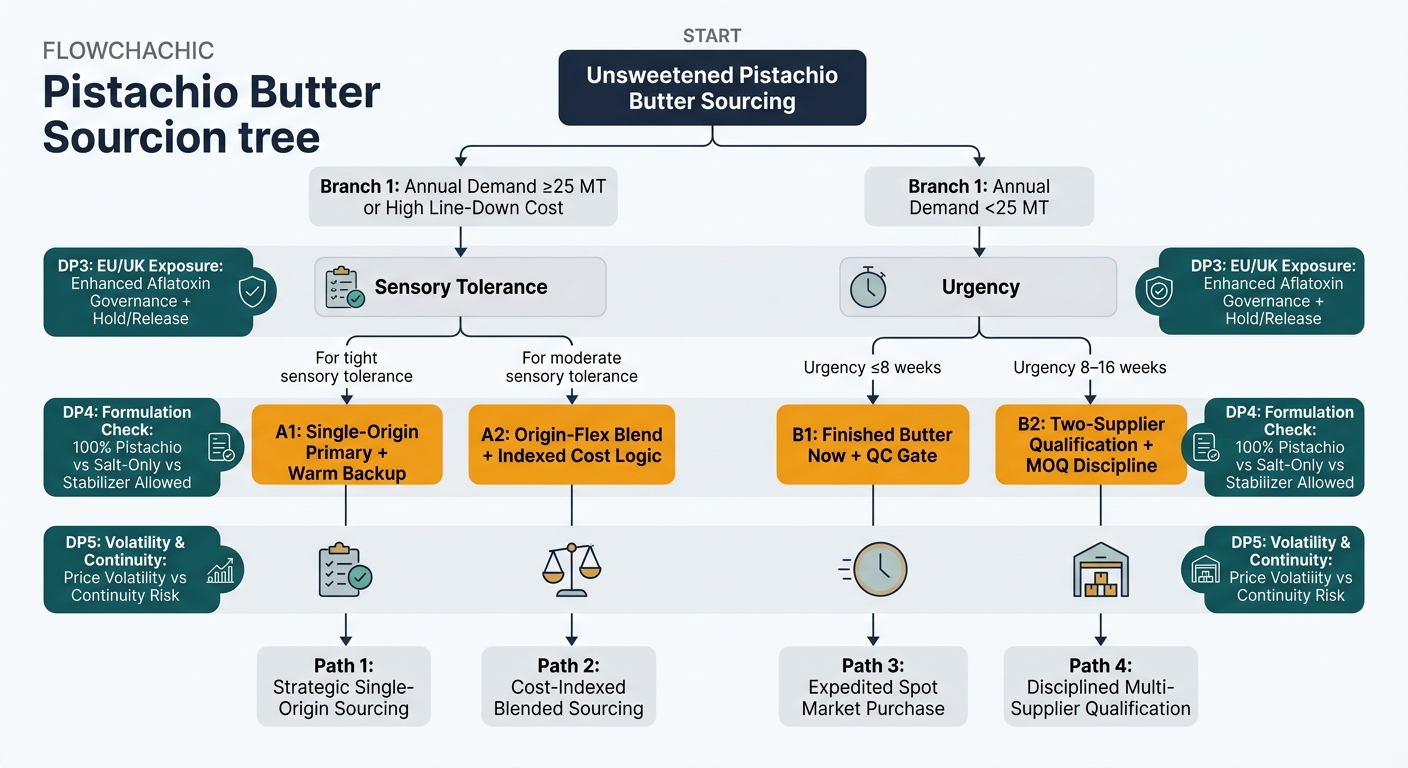
Insight: The “right” pistachio butter strategy depends on five variables that you can threshold: volume, urgency, spec tightness, compliance burden, and risk tolerance.
Data: Food safety thresholds materially differ by market: FDA lists an aflatoxin action level for pistachio nuts at 20 ppb, while EU contaminant rules set strict maximum levels for aflatoxins in tree nuts and processed nut products (category-dependent). [3]
Procurement Impact: You should branch early on compliance and spec, because those constraints determine which suppliers are even eligible—and how much testing/hold-time you must plan for.
Quick Win: Write a one-page “spec governance memo” that states what can flex (origin blend, roast window) and what cannot (contaminant limits, allergen controls). That memo prevents emergency substitutions later.
Insight: The same market can justify opposite strategies depending on where your value is created (brand consistency vs throughput vs compliance).
Data: U.S. supply leadership and alternate-bearing crop cycles mean allocation dynamics recur—especially in years following record crops and during “off years.” [1]
Procurement Impact: Scenario-based reasoning helps you pre-approve trade-offs so you don’t renegotiate your strategy in the middle of a shortage.
Quick Win: In urgent buys, don’t waive governance—compress it. Require a complete COA pack and define “release-to-ship” rules before you place the PO.
Insight: A simple buyer-profile matrix prevents teams from defaulting to one-size-fits-all RFQs.
Data: Regulatory thresholds and official-control expectations differ across markets (e.g., FDA action levels vs EU maximum levels), changing supplier eligibility and lead times. [3]
Procurement Impact: You can standardize strategy selection and governance documentation across business units.
| Buyer Profile | Key Factors | Recommended Strategy | Expected Outcome |
|---|---|---|---|
| Premium retail, EU exposure | Tight sensory + strict contaminant governance | Single-origin primary (60–80%) + warm backup (20–40%) + formal hold/release | Lower recall/compliance risk; fewer brand-impacting lot swings |
| Industrial high volume | ≥100 MT; moderate sensory tolerance | Origin-flex blend + indexed review triggers + dual-source | Lower cost variance; better allocation resilience |
| Mid-volume U.S. retail private label | 25–75 MT; cost pressure; stable spec | 70/30 dual-source + MOQ/lead-time protections | Reduced stockout risk; improved negotiation leverage |
| New product launch (low volume) | <25 MT; <8 weeks | Finished butter now + QC gate; qualify #2 in parallel | Faster launch with controlled quality risk |
| Single-supplier legacy program | >70% on one supplier/origin | Build warm backup; trial lots; pre-approved substitution rules | Reduced single-point failure; faster contingency activation |
Quick Win: Put this table into your category playbook and require teams to select a row (and justify deviations) before issuing an RFQ.
Insight: Pistachio butter failures show up first as quality drift (oxidation/separation) or compliance holds (aflatoxin testing/release), not as obvious “no supply” signals.
Data: FDA identifies tree nuts (including pistachios) as susceptible to aflatoxins and publishes action levels; EU sets maximum levels for aflatoxins in relevant nut categories, driving official-control scrutiny and potential shipment holds. [5]
Procurement Impact: If you define early-warning metrics and triggers, you can shift volume before you breach service level or quality KPIs.
Quick Win: Add a “release checklist” to every PO: COA fields required, reject rules, and who signs off (QA vs procurement). That single control prevents most emergency-quality disputes.
Insight: Your highest-ROI move is to formalize dual-sourcing and governance triggers before the market tightens, because pistachio supply is seasonally produced but consumed year-round.
Data: California harvest timing concentrates supply availability into a seasonal window; food safety governance is non-negotiable due to aflatoxin susceptibility and market-specific limits (FDA action levels vs EU maximum levels). [2]
Procurement Impact: A documented strategy (coverage %, backup readiness, and release criteria) reduces emergency buys, improves budget predictability, and creates audit-ready rationale.
Logical Next Step (non-promotional): If you can’t answer—by supplier and by origin—how much of your next 90 days’ demand is already covered, what your aflatoxin release criteria are for each destination market, and how fast you can switch 30% of volume to a backup, you don’t have a sourcing strategy yet—you have a hope-and-expedite plan.
(Analyzed at: Jul, 2026)
U.S. pistachio supply remains the global swing factor—USDA has documented multi-year U.S. leadership and material year-to-year variability driven by alternate bearing, which is exactly what turns “single supplier + single origin” programs into allocation events. [1] Your highest-conviction move is to contract 60–80% coverage with EU/FDA-ready aflatoxin governance (sampling + hold/release) and keep a qualified warm backup for 20–40% so you can shift volume without re-validating your entire spec mid-crisis. [3] Teams that wait until a crop-driven squeeze typically end up paying for expedite freight, short-ship penalties, and rework—costs that can easily dwarf a “better price” by several percentage points over a season.


