

Frozen organic açaí is a constraint-driven category: origin concentration, organic governance, and cold-chain execution determine whether you can keep supply moving without last-minute spec waivers or documentation surprises. This decision-tree is written for Risk & Sustainability procurement teams who need a defensible sourcing architecture—one you can embed into supplier scorecards, audit packs, and contingency plans.
Frozen organic açaí procurement fails most often at the decision layer (how you structure origin, supplier bench, lanes, and contracts), not at the negotiation layer.
Brazil is the dominant global producer (often cited around ~90–95% of global production), and the state of Pará is repeatedly reported as the overwhelming center of national output and value—creating structural origin concentration risk for export buyers. [1]
Use this framework when you need a defensible answer to: “How do we keep organic integrity and quality consistent while protecting supply continuity and landed-cost stability?”—and you want that answer embedded into specs, qualification, and contingency plans (not tribal knowledge).
Quick Win: Treat “continuity” as a pre-qualification deliverable (bench + lanes + documents), not as an emergency spot-buy capability.
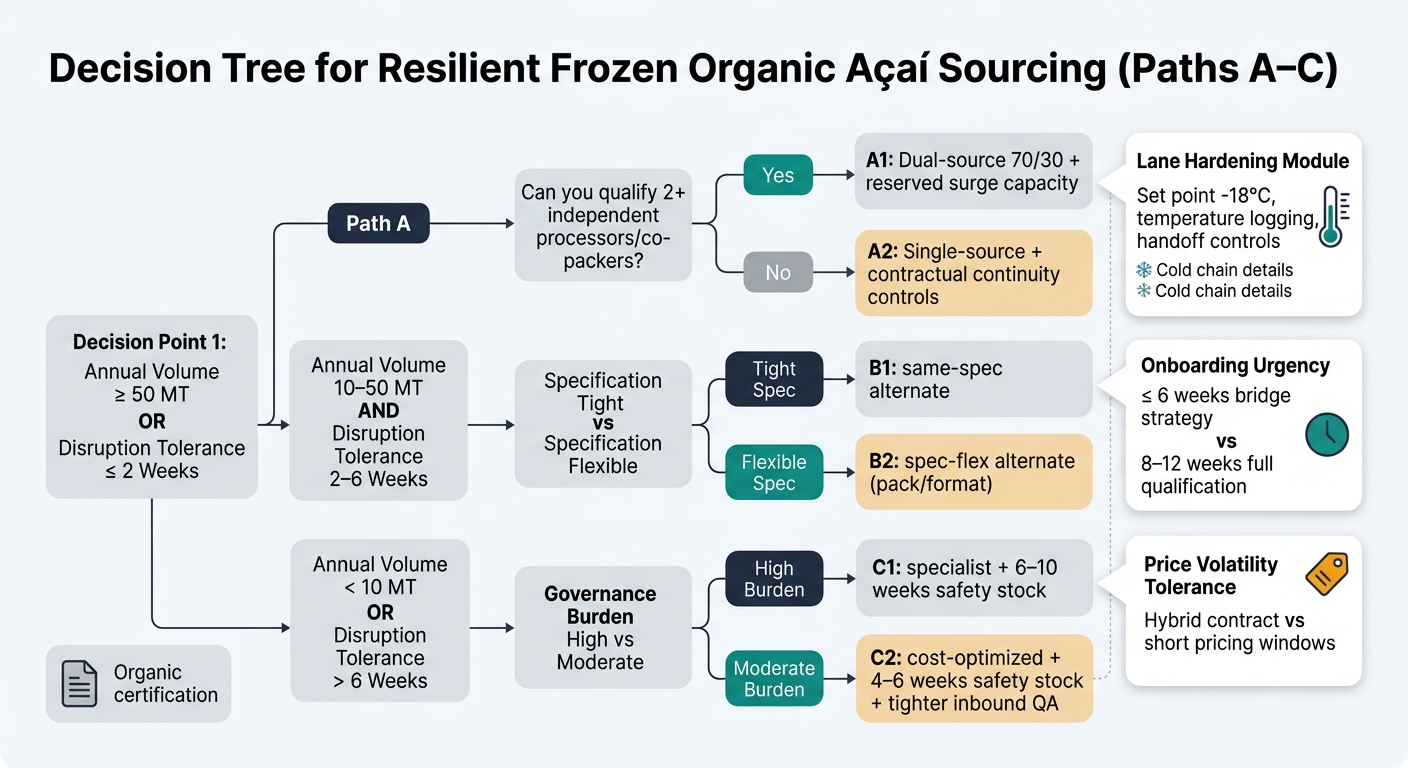
Your optimal strategy is determined by five inputs: annual volume, time-to-switch tolerance, spec tightness, organic governance burden, and cold-chain fragility.
-18°C is widely referenced as the reference temperature for storage/distribution of quick-frozen foods in international guidance; deviations can increase quality-loss risk and downstream defects/complaints even if the product remains frozen. [2]
If you cannot tolerate a lane failure or documentation gap, you must pay for optionality upfront (second source qualification, reserved capacity, and lane redundancy) or accept higher stockout/expedite exposure later.
Quick Win: Before talking price, align internally on two thresholds: “max acceptable weeks of interruption” and “max acceptable spec flexibility.” Those two numbers determine your sourcing architecture.
Frozen organic açaí is a “constraint-driven” category—processing capacity, organic documentation, and cold-chain performance constrain your supplier universe more than farmgate fruit availability alone.
Pará is repeatedly reported as the dominant production/value hub for Brazilian açaí—meaning your supply risk is tied to a concentrated geography and its logistics/processing nodes. [4]
Your decision tree should force early choices on (1) how much optionality you need and (2) where you allow flexibility (origin, format, pack, or spec)—so you don’t discover constraints during a disruption.
Quick Win: Decide where you allow flexibility (origin/format/pack/spec). If you allow flexibility nowhere, your only lever is inventory—and you’ll pay for it.
The same market reality (origin concentration + cold chain + organic governance) produces different optimal strategies depending on your disruption tolerance and spec rigidity.
USDA organic handling rules require measures to prevent commingling and contact with prohibited substances—so governance gaps can appear as “paper failures” before they appear as quality failures. [3]
Walkthroughs show how to translate risk posture into artifacts: supplier scorecards, spec language, lane SOPs, and contingency triggers.
Quick Win: In urgent launches, relax only one dimension (pack or format), not three. Keep organic documentation and lane controls non-negotiable.
Açaí strategies are best compared by “time-to-switch” and “governance readiness,” not unit price.
Concentrated production/value in Pará and the dominance of Brazil in global supply mean your resilience comes from qualification depth, lane redundancy, and documentation discipline more than from chasing marginal supplier price differences. [1]
This table can be copied into a category strategy deck or risk register as your “default playbook by profile.”
| Buyer Profile | Key Factors | Recommended Strategy | Expected Outcome |
|---|---|---|---|
| High-volume QSR / smoothie chain | ≥ 50 MT/year; disruption tolerance ≤ 2 weeks; fixed SKU | Dual-source (70/30) + reserved surge capacity + lane hardening + hybrid contract | Fewer stockouts/expedites; faster switchability; steadier landed cost |
| Mid-size retail private label | 10–50 MT/year; strict label/claims; pack rigidity | Primary + same-spec alternate; full qualification; tighter inbound QA | Fewer holds and relabel events; stronger audit readiness |
| Industrial user (blends/co-man) | Variable demand; can accept format flexibility | Primary + spec-flex alternate (format/pack); trigger-based buys | Lower total cost-to-serve; improved continuity |
| Emerging brand (launch-driven) | < 10 MT/year; urgent ≤ 6 weeks | Bridge contract (time-boxed) + strict organic governance + lane trial | Launch protected with controlled risk; avoids governance failures |
| ESG-sensitive buyer (high scrutiny) | High questionnaire/audit load; reputational risk | Documentation-first supplier selection + higher safety stock + tighter CoC mapping | Fewer claim escalations; faster customer responses |
Quick Win: Add “time-to-switch (weeks)” as a scored field in your supplier scorecard; it’s the best single proxy for resilience in frozen organic categories.
In frozen organic açaí, the highest-frequency failures are (1) documentation gaps (organic scope/chain-of-custody discontinuities) and (2) cold-chain performance drift; both are detectable earlier than a full supply outage.
USDA organic handling rules require controls to prevent commingling/prohibited substance contact—so lapsed/incorrect certificates and scope mismatches are common “silent” risks if not monitored and re-verified on change events. [3]
Build monitoring into your governance cadence (monthly/quarterly) with clear triggers that force pre-defined actions (activate alternate, build stock, freeze spec changes).
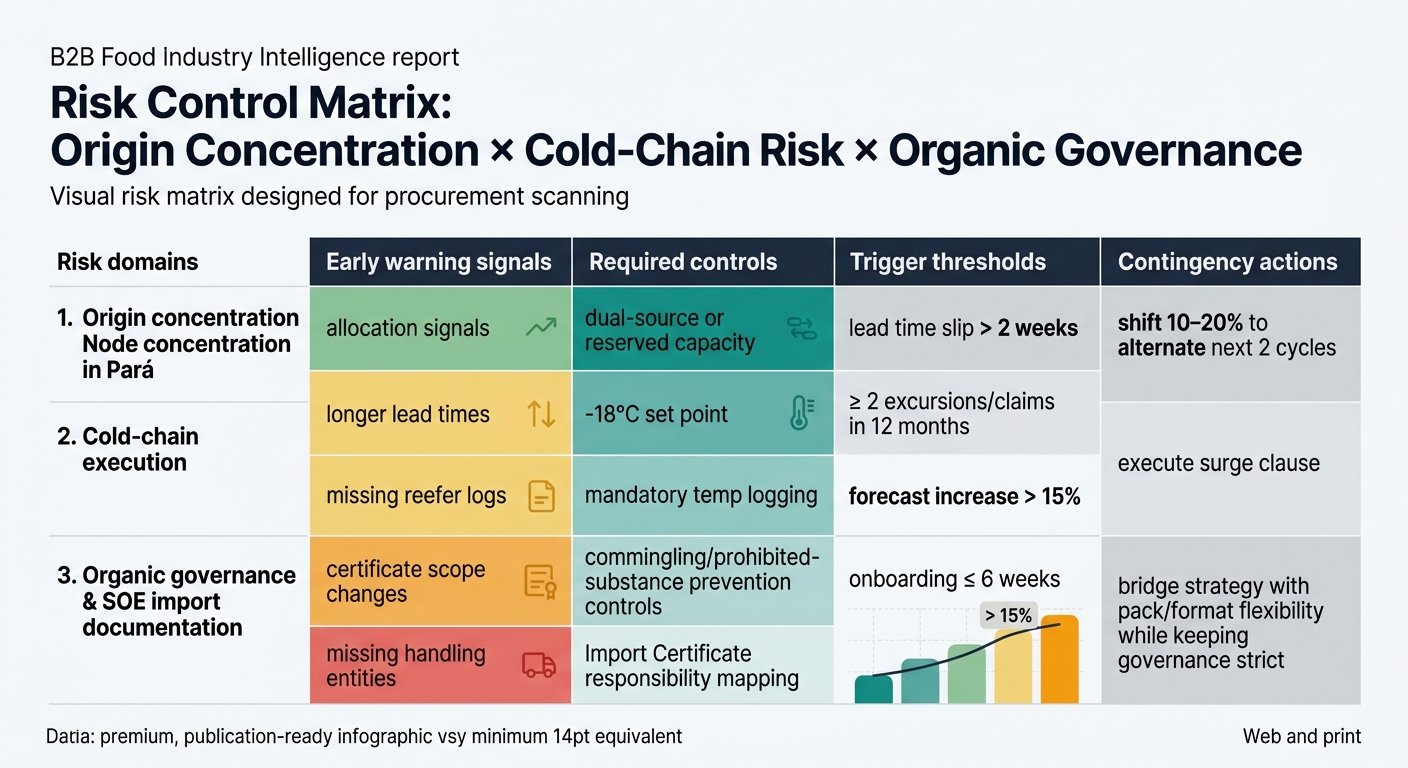
Quick Win: Require two pieces of evidence on every inbound load: (1) reefer temperature log and (2) complete organic document packet mapped to the certified handling entities. This catches the two most common failure modes early.
The most defensible near-term move is to buy “switchability” (pre-qualified alternate + lane readiness) rather than trying to out-forecast price swings in a concentrated, cold-chain-dependent origin.
Brazil’s açaí supply remains large and growing (USDA FAS estimated 2026 Brazilian production at ~2.0 MMT vs. ~1.8 MMT in 2025), but your export risk is still shaped by concentrated nodes (processing/logistics) and compliance friction (SOE import governance). [6]
If you can cut time-to-switch from “months” to “weeks,” you reduce expedites, avoid spec waivers, and lower the probability of organic/claims surprises during disruption.
Most teams can’t answer, with evidence, “How many weeks would it take us to switch supply without relaxing organic governance or cold-chain controls?” Building a measurable, auditable time-to-switch baseline (by supplier, lane, and spec) is the fastest way to turn açaí sourcing from reactive firefighting into governed risk management.
(Analyzed at: Sep, 2026)
USDA FAS is signaling continued growth in Brazilian açaí output in 2026 (roughly 2.0 MMT vs. 1.8 MMT in 2025), which can make buyers complacent—but the real failure modes in frozen organic açaí are still node concentration + cold-chain execution + SOE-era import documentation friction. Put one high-conviction clause set into your next contract: (1) a lane-tested alternate (or pre-approved pack/format fallback), (2) mandatory reefer data logging at receipt, and (3) explicit organic handling/Import Certificate responsibilities. The cost of that optionality is usually smaller than a single missed promotion window or an expedite cycle that can quietly add mid-single-digit percentage points to your landed cost.


